
The Indian Army has set up two armoured vehicle maintenance and repair facilities near the China border in Nyoma and the DBO Sector in that region at altitudes of over 14,500 feet in the area, which is the world's highest battlefield for tanks and infantry combat vehicles along the LAC in Eastern Ladakh.

Spokesperson in the MEA Anurag Srivastava said both sides have agreed to work for an early resolution to the issue in keeping with broader guidance provided by leaders of the two countries for ensuring peace and tranquillity along the border areas. He, however, did not respond to questions relating to reports of pulling back of troops by both India and China from certain friction points in the Galwan Valley and Hot Spring areas in eastern Ladakh in the last few days.

The talks between India and China on the border row in eastern Ladakh have helped 'build trust' and the situation in the region has been normal since the disengagement in the Pangong Tso areas in February, Chief of Army Staff General M M Naravane said on Thursday, exuding confidence of resolution of the 'remaining issues'.
The Heron unmanned aerial vehicles are already in the Air Force, Navy, and the Army and are being used extensively at the moment by both Army surveillance and Target acquisition batteries and Air Force in the Ladakh sector.

The Indian Army is looking at deploying over 350 light tanks, mostly in the mountainous border areas.
China and India have made 'positive progress' to resolve the border standoff, with both sides maintaining close communication through diplomatic and military channels, a senior foreign ministry official said in Beijing on Friday.

'Our brave Indian soldiers don't reply to raining of bricks with mere sticks, they do so with iron rods'
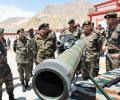
The Army has significantly bolstered its fire power along the frontier with China by deploying a range of rockets and artillery weapons and plans to procure an array of additional systems, including 100 K9 Vajra howitzers and UAVs, to augment combat prowess.

'We should not allow ourselves to be surprised in any manner in future on the border.'

'China did not expect India to show such strategic resolve in defending its territorial integrity.'
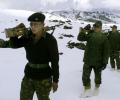
They said the Chinese troops came to the Indian side of the border in the garb of nomads and pitched the tents.

The MEA said the two sides shared their perspectives on the matter in the talks held in a friendly and cordial atmosphere.

Jaishankar said the last few years have been a "period of serious challenge", both for the relationship and for the prospects of Asia, noting that continuation of the current impasse will not benefit either India or China.

Jaishankar said, "The immediate part which awaits us is what we call the de-escalation, which is the build-up of forces along the Line of Actual Control."
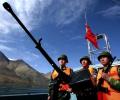
The Chinese side has particularly bolstered its presence in the Galwan Valley, erecting around 100 tents in the last two weeks and bringing in heavy equipment for construction of bunkers, notwithstanding the stiff protest by Indian troops. There have been reports of multiple incidents of transgressions by Chinese troops in several areas in Eastern Ladakh.

Prime Minister Narendra Modi and Chinese President Xi Jinping were on Thursday seen having brief exchanges ahead of a media briefing by the BRICS (Brazil-Russia-India-China-South Africa) leaders in Johannesburg.

The sources said the military brass is considering deploying Indian Navy's MiG-29K fighter jets in a couple of air bases in the northern sector as part of efforts to bring in tri-services synergy in dealing with national security challenges.
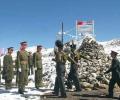
The force also stated that such incidents happen due to differing perceptions of the LAC and there are established mechanisms to resolve such differences.

India and China have agreed to work towards a "roadmap" for rebuilding mutual trust following the border standoff in eastern Ladakh, according to a statement from the Indian Defence Ministry. Defence Minister Rajnath Singh met with his Chinese counterpart Dong Jun in Vientiane, Laos, on the sidelines of a regional security conclave. Singh called for drawing lessons from the "unfortunate border clashes" of 2020 and emphasized the need for cooperation rather than conflict. Both sides agreed to work towards a roadmap for rebuilding mutual trust and understanding, and a meeting of the Special Representatives and Secretary-Vice Minister mechanism will also take place soon.
Many of them sustained minor injuries in the clash near Naku La in the Sikkim sector along the Sino-Indo border on Saturday

Singh said if there is an attempt to hurt the self-respect of India, then it will not be tolerated and will be given a 'befitting reply'. "Whatever progress has been made in the talks, there should be a resolution of the matter. But to what extent it will be resolved, I cannot guarantee."

China plans to build a new highway along the Line of Actual Control (LAC) with India as part of Beijing's efforts to strengthen its strategic position and project its power, a media report said on Wednesday.
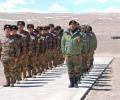
The sources said both sides held extensive deliberations on modalities for disengagement of troops from all the friction points in eastern Ladakh at the talks.
The action against Zakir Hussain, a councillor from Shakar constituency in Kargil district, followed registration of a first information report against him by police on Friday even as the councillor submitted a public apology over his remarks, the officials said.

In the talks, China emphasised that the two sides should proceed from the fundamental interests of China, India and adhere to the strategic height and long-term perspective of China-India relations, the readout said.

India and China on Thursday vowed to redouble efforts to resolve the remaining issues in eastern Ladakh at the earliest and 'stabilise and rebuild' ties even as External Affairs Minister S Jaishankar conveyed to his Chinese counterpart Wang Yi during a meeting that the Line of Actual Control (LAC) must be respected.

The Jaishankar-Wang talks came amid the dragging border row in eastern Ladakh that entered its fifth year in May.
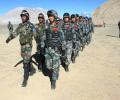
The talks between the two armies are going to be held this week at multiple locations including Patroling point 14 (Galwan area), Patrolling point 15, and Hot Springs area, top government sources said.

'The border stand-off and the uncertainties that come with it should be a wake-up call on what makes for real rather than illusory power,' observes T N Ninan.
China routinely objects to Indian leaders' visits to Arunachal Pradesh to buttress its stand.

According to sources, the post at which the Chinese army has put up loudspeakers is under 24x7 constant watch by Indian soldiers and it is possible that the Chinese might be indulging in such drama to distract our troops or perhaps just relieve the pressure.
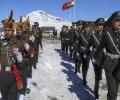
In a joint statement, the two armies said it was agreed to earnestly implement the important consensus reached by the leaders of the two countries and ensure that the frontline troops exercise restraint and avoid misunderstanding and miscalculation.

Following the disengagement, both sides will soon start the coordinated patrolling in their respective areas, sources added.
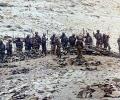
"We have seen movements in training areas. It is an annual exercise. They come for training. We also go to training areas. We have been keeping a constant eye on it. We have forces along the LAC and they are adequate to deal with any action or activity," Gen Naravane told India Today channel.

The ministry of external affairs on Wednesday said the talks were held in an "open and constructive manner" for an early and mutually acceptable resolution of the remaining issues.
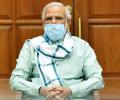
The world has seen India's strength and commitment to protecting its borders and sovereignty, he said and paid rich tributes to the 20 soldiers who were killed during a violent clash with Chinese troops.
This meeting is taking place after a gap of around four months.

Lauding the bravery displayed by the soldiers, the prime minister said: "The bravery that you and your compatriots showed, a message has gone to the world about India's strength."

The commander said the situation in the region has been stable and no major "changes or palpable shift of stance has been noted" even as the Indian and Chinese troops are engaged in a stand-off in Demchok and Depsang in eastern Ladakh.

Both sides have completed creation of a buffer zone of three kilometres in the three friction points of Galwan Valley, Gogra and Hot Springs as part of a temporary measure aimed at reducing the possibility of any confrontation.
